Skip Hire in Stafford
Stafford is a town where the right skip is usually decided by the age of your house rather than the size of the job. A bathroom in a Victorian terrace near the town centre produces a very different load from the same bathroom in a 1970s house in Wildwood, and a garden clearance in Rowley Park is a different proposition to one on a new plot at Burleyfields.
We are based at Whiston Mill in Penkridge, about five miles down the A449, and we hire skips from 4 to 14 yards across the county town and the villages around it. This page explains what we would tell you on the phone: which size actually suits your job, whether you need a permit, and what will happen on delivery day.
What being five miles away actually changes
Stafford is the county town, so it draws skip companies from Stoke, Cannock, Wolverhampton and further out. For most of them Stafford is a satellite: a run they will do when the load makes sense. That is why delivery windows stretch and why collections slip a few days.
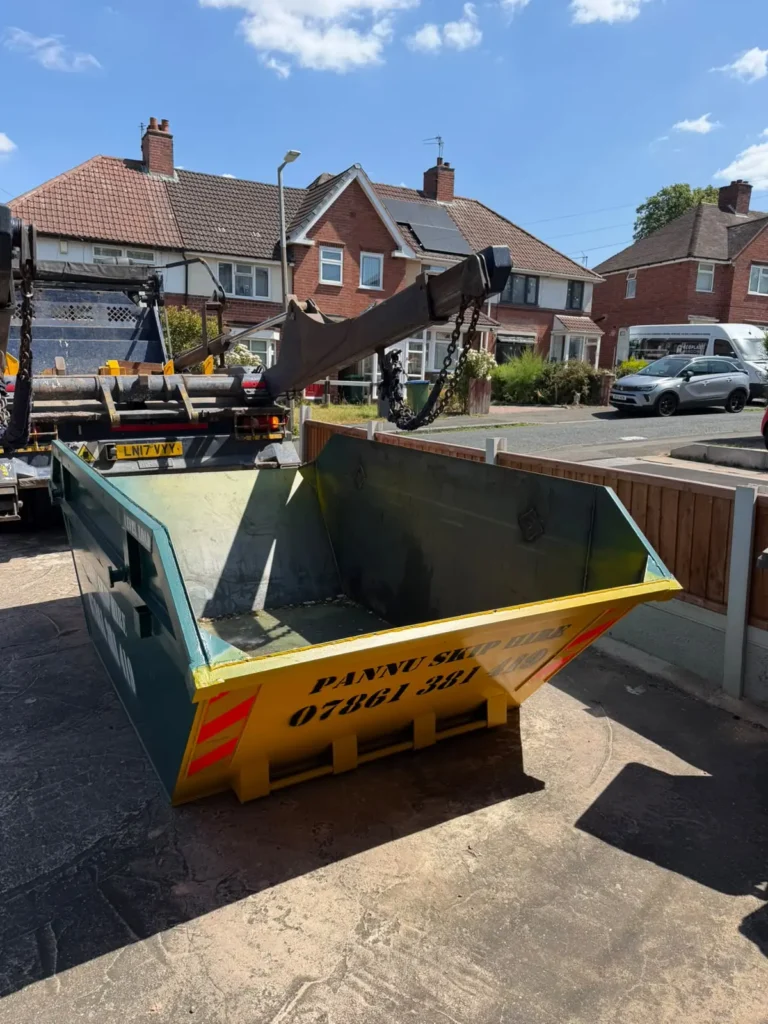
Distance decides what a company can honestly promise
Our yard is roughly five miles south on the A449. That does not make us better at loading a lorry, but it does change what we can commit to. A same day drop in Stafford is a genuine possibility for us rather than something we hope you will not test. If a job finishes early and you want the skip gone, we are not routing a vehicle back from a different county to do it.
Knowing which side of the town to come in on
Stafford sits between two M6 junctions, 13 to the south and 14 to the north, with the A34 running through the town, the A449 coming up from Penkridge and Wolverhampton, and the A518 heading out towards Uttoxeter. Which one we use is not a detail, it decides the delivery.
For anything in the south and east of the town, Baswich, Weeping Cross, Wildwood, Queensville or Rickerscote, we come up the A449 and never touch the centre. For Beaconside, Redhill and the northern estates, junction 14 and the A34 make more sense. Getting this right is most of what separates a delivery that lands at nine in the morning from one that lands mid afternoon.
Collections that move when the job moves
Building work overruns. That is not a failure, it is normal. Plaster takes longer to dry than anyone allows for, a roofer loses two days to weather, a clearance turns out bigger than the family expected.
Being close means we can usually leave a skip a few days longer, or swap a full one, without it wrecking the week. We would rather do that than hold you to a slot that no longer matches the work.
Two different conversations, not one script
A homeowner in Holmcroft is deciding whether a 6 yard will fit on the drive without blocking the car. A site manager on a commercial fit out wants to know whether we can swap a skip inside a working day. Those are genuinely different problems and we do not pretend otherwise.
We are registered with the Environment Agency as a waste carrier, registration CBDU576197. If you are a business, checking that on the public register is part of your duty of care rather than a courtesy.
Which size you need, and why Stafford housing decides it
4 yard mini skip
The right answer far more often than people expect, for two reasons.
First, weight. Soil, brick, concrete, hardcore and old floor tiles reach the safe lifting limit long before they fill the container. If you are digging out for a shed base in Coton Fields or lifting a path, a 4 yard is not a compromise, it is the correct choice.
Second, space. The Victorian and Edwardian streets around the town centre have short frontages and, in many cases, no driveway at all. A 4 yard occupies the least kerb, which matters when a placement has to leave the footway clear. Typical uses are a bathroom strip out, a garage clearance, a small garden tidy, or the tail end of a decorating job.
6 yard skip
The most ordered domestic size in Stafford, and the natural fit for the town’s large stock of three bedroom semis in Highfields, Holmcroft, Rising Brook and Littleworth. A full kitchen removal, units, worktops, appliances, flooring and tiling, sits comfortably in a 6 yard, and it still fits on a standard driveway of that era without blocking the whole thing. It is also the usual size for a landlord clearing a property between tenancies.
8 yard builders skip
The default on site. Extensions, re roofs and full refurbishments produce mixed waste in volume: timber, plasterboard offcuts, broken tile, packaging and old units.
One caution specific to roofing. A skip filled entirely with concrete tiles will reach its weight limit while still looking half empty. Tell us the tile type when you book and we will advise properly rather than let you order something we cannot lift.
10 yard skip
Volume without weight. Loft conversions are the clearest example: decades of stored belongings, old insulation, boarding and boxes, almost none of it heavy. Full house clearances behave the same way when the contents are furniture and soft goods rather than rubble.
12 yard and 14 yard maxi skips
Private land only. These are too long to be permitted on the public highway, so they are not available for a street placement anywhere in Stafford.
Where they earn their keep is on commercial and industrial premises with their own yard: units on Staffordshire Technology Park, Beacon Business Park or the estates around Redhill, and on development plots. Office strip outs and retail refits suit them particularly well, because partition board, ceiling tiles, shelving and workstations take up far more room than they weigh.
Full dimensions for every size are on our skip sizes page.

What each type of job actually produces
Most people book by describing a room. It is more useful to describe the material, because weight rather than volume is what limits a skip. Here is how the common Stafford jobs tend to work out.
Kitchen renovations
A 6 yard for most Stafford semis. Break down the carcasses before loading; a dismantled unit uses a third of the space. Worktops are heavier than they look, particularly stone or composite.
Bathroom renovations
A 4 yard usually covers it, but this is a weight job rather than a volume one. A cast iron bath, wall tiling and floor screed can fill the weight allowance while the skip still looks half used.
Garden landscaping
Green waste is bulky and light; soil and old paving are dense and heavy. These two behave in opposite ways. If a job involves both, it is often cheaper to run a smaller skip for the heavy material than to put everything into one large one.
Loft conversions
Almost entirely volume. Old insulation, boarding, stored belongings and packaging. A 10 yard is usually right, and it is one of the few domestic jobs where going bigger genuinely saves money.
House extensions
Continuous waste over weeks rather than a single load. Most extensions run through at least one 8 yard, often more if there is muck away from the footings. A rolling swap arrangement is simpler than booking each time.
Office clearances
Desks, chairs, partitioning, filing and cabling. Volume driven and awkwardly shaped. Plan around building access and lift availability rather than road access, particularly in the town centre.
Retail refurbishments
Shopfronts, counters, shelving, signage and flooring. The complication in Stafford is that many town centre units have no rear service access, which pushes the skip onto the highway and into permit territory. Start that conversation before the trades are booked.
Warehouse clearances
Pallets, packaging, racking and obsolete stock. Nearly always private land, which means maxi skips are available and no permit is needed.
Construction waste
Mixed by nature and usually heavy at the bottom of the load. Keep plasterboard separate; it needs its own disposal route and contaminates a mixed load if it is buried in the middle.
Commercial projects
Timing tends to matter more than volume. Work often has to happen outside trading hours, and a collection at opening time is rarely welcome. Tell us the constraint and we will work to it.
Property clearances
Often difficult as well as practical, particularly probate clearances. Volume is usually underestimated because furniture is bulky. A 10 yard is a safer starting point than a 6 for a full house.
Rental property refurbishments
Short windows between tenancies. A skip delivered the day a tenancy ends and collected once the work is done is the usual pattern, and speed of collection matters more here than anywhere else.
Stafford housing, era by era, and what each one throws out
This is the part most skip pages leave out, and it is the most useful thing we can tell you. Stafford grew in distinct waves, and the era of your property predicts both the waste and the access problem.
The Victorian and Edwardian core
The older streets close to the centre and around Rowley Park and Forebridge. Narrow frontages, small forecourts, frequently no off street parking.
The waste is distinctive: lath and plaster, cast iron, dense old timber, chimney rubble and thick floor screeds. It is heavier than modern equivalents, which is why a 4 yard is often the right call even when the job feels bigger. Access is the real constraint here, and a skip on the road means a permit.
Interwar and post war estates
Highfields, Holmcroft, Littleworth, Rising Brook and Coton Fields. Semi detached houses, decent gardens, driveways that will usually take a 4 or 6 yard without blocking the whole frontage.
This is the heartland of kitchen and bathroom refits, garage clearances and driveway replacements. Access is generally straightforward, and most skips go on private land, which removes the permit question entirely.
The 1960s to 1980s suburbs
Wildwood, Baswich, Weeping Cross, Rickerscote and Queensville. Wider plots, longer drives, larger gardens and integral garages.
Two things follow. Garden and landscaping work is more common because the plots are bigger, and garage clearances produce more volume. Access is rarely a problem, and there is usually room for an 8 yard on private land.
New build Stafford
Burleyfields at Castlefields, Redhill and the newer parcels around the edges. Modern estate roads are wide but frequently have restricted parking, shared drives and tight turning heads, and unfinished phases can have construction traffic moving through them.
The waste profile is different again: packaging, offcuts, turf and subsoil from landscaping a new garden, and fit out waste rather than demolition waste. New build gardens are usually landscaped within the first couple of years, which is a steady source of green waste and spoil.
Commercial and industrial premises
Units on Staffordshire Technology Park at Beaconside, Beacon Business Park, and the estates around Redhill in the north of the town. Yard space is generally available, so maxi skips are an option, and access for a lorry is designed in rather than improvised.
Getting a skip into a Stafford street
The town centre
Compact, partly pedestrianised, and built around streets that predate lorries. Most town centre placements need a permit and careful thought about where the skip can sit without obstructing the footway. Retail and office work here nearly always needs more lead time than the customer expects, because the permit has to be in place before the skip arrives and the placement may need to be assessed.
Coming in from the south
The A449 from Penkridge and M6 junction 13. This serves Baswich, Weeping Cross, Wildwood, Queensville, Rickerscote and the southern approaches. It is our most common route and the quickest for us.
Coming in from the north
M6 junction 14 and the A34. Best for Beaconside, Redhill, Holmcroft, Tillington and the northern estates. It also serves the Staffordshire Technology Park and Beacon Business Park side of the town without crossing the centre.
The eastern side and Beaconside
Mixed commercial, education and residential. Access is broadly good, roads are wider and there is generally room to manoeuvre. This is easier territory for larger skips.
Doxey, Castletown and the western edge
Close to the railway and the River Sow, with a mix of older housing and newer development. Some streets here are narrow and parking is tight, so timing matters. An early slot before cars fill the kerb is worth more than any other bit of planning.
Why the tip is not the free option people assume
It is reasonable to weigh a skip against a few trips to Stafford Recycling Centre on St Albans Road. Worth knowing the actual rules first.
Visits in a car are unlimited and need no permit. But if you use a van, a pick up, or a trailer over 1.5 metres, you need a permit, and that permit allows 12 visits per year. Rigid plastics are currently not accepted at any Staffordshire recycling centre, and the Stafford site has been experiencing longer queues.
For a couple of car loads the tip is genuinely the sensible option and we will say so. For a trade, for anyone with a van, or for any job beyond a few loads, the 12 visit cap makes a skip the simpler answer.
What is being built in Stafford, and why it matters
Burleyfields and the West Stafford allocation
The largest thing happening in the town. Up to 1,500 homes have been allocated on land at Castlefields as part of the Burleyfields development, on the western side of Stafford. The wider site covers 67.34 hectares, around 166 acres, and is known in planning terms as the West Stafford Strategic Development Location, one of the largest housing allocations in the borough.
Phases 1, 2A, 2B, 3 and 4 are already under construction at varying stages. In May 2026 Taylor Wimpey submitted detailed plans for Phase 5, the final phase, covering up to 285 homes, with an allotment to the south west, a play area to the south east, and a landscaped bund and attenuation basin along the western edge. The houses are a mix of detached, semi detached and terraced, in two, three and four bedroom formats.
A new Local Plan is being written
Stafford Borough Council stopped work on its Local Plan 2020 to 2040 following a Cabinet decision in March 2025 and began a new Local Plan covering 2025 to 2045. An initial consultation was scheduled to run from 8 June 2026 until late July 2026, covering the whole borough including Stone, and dealing with housing, employment, transport, flooding, heritage and the countryside.
For anyone planning building work, the practical point is that the planning framework for the next twenty years is being decided now.
What this means for waste
Large housebuilders have their own contracted arrangements, so we are not going to claim we service the Burleyfields site itself. The work that reaches a firm our size is what follows.
New estates generate landscaping waste as gardens are finished, then extensions, garage conversions and driveway work in the years after. Meanwhile the existing housing stock keeps turning over: an expanding town means more sales, more refurbishments before sale, and more rental turnaround. That is where our Stafford work actually comes from.
Permits in Stafford, and how the two tiers work
Driveway or highway
If the skip sits entirely on your own driveway or private land, there is no permit and no council involvement. The majority of our Stafford deliveries fall into this category.
If any part of it sits on the public highway, which includes the road, the footway and the verge, a permit is required.
Two councils, one of which handles this
Stafford has two tiers of local government and it catches people out. Stafford Borough Council handles planning, bin collections and local services. Staffordshire County Council is the highway authority, and it is the county council that issues skip permits.
If you have been looking on the borough council website for a skip permit, that is why you could not find it.
The application has to come from us
Staffordshire County Council requires applications to be made by the company delivering and placing the skip, and that company must be registered with the authority before any application can be processed. You cannot apply for your own skip permit.
So the process from your side is short: tell us the skip is going on the road, and we deal with the application and the conditions.
What the county council requires
The permit must be in place before the skip is put on the highway. The permit holder indemnifies the council against liability arising from the skip and must repair any damage to the highway at their own expense. Public liability insurance of at least £5 million for any one claim, with no limit on the number of claims, must run for the full permit period.
Skips must not endanger road users or obstruct drainage, access to premises, fire hydrants, gullies, manholes or utility apparatus, and all highway users must be considered, including people with mobility or visual impairments. Deposit and collection are restricted to between 07:30 and 20:30 unless a special condition applies.
Lead times
Because the permit must be granted before the skip goes down, a highway placement needs more notice than a driveway drop. On town centre and older residential streets, where placement may need assessing, allow more time still. If your job is time critical and the road is your only option, tell us at the point of enquiry rather than the day before.
We are setting out the council’s published requirements here rather than giving legal advice. Current conditions and fees are on the Staffordshire County Council skip permit pages.
What can and cannot go into your skip
Accepted waste
- General household waste, including furniture, carpets, boxes and non electrical fittings
- Wood and timber, from floorboards and joists to fencing, pallets and kitchen carcasses
- Metal such as radiators, gates, railings, guttering and pipework
- Brick, concrete and hardcore, which are dense, so smaller skips apply
- Soil and turf from excavation and landscaping, within weight limits
- Garden and green waste, including hedge cuttings, branches, prunings and turf
- Furniture, broken down where possible to save space
- Cardboard and packaging, common on new build fit outs and retail work
- Plastics, including guttering, non hazardous fittings and packaging
- Mixed construction waste, the normal output of most building jobs
- Plasterboard, accepted but kept separate because it needs its own route
What cannot go in, and why
- Asbestos. Hazardous and tightly controlled. Common in garage roofs, artex, older floor tiles and insulation board in properties of a certain age, which covers a great deal of Stafford housing. If you suspect it, stop and have it identified. It requires a licensed specialist.
- Paint, solvents, oils and chemicals. Liquid hazardous waste contaminates a whole load and cannot be separated afterwards. Dried empty tins are generally fine, part full ones are not.
- Tyres. Banned from landfill and required to go through a dedicated recycling route.
- Fridges, freezers and air conditioning units. Refrigerant gases must be extracted under controlled conditions first.
- Televisions, monitors and electrical items. Covered by separate electrical waste regulations.
- Batteries. Heavy metals and acids, and a genuine fire risk in a mixed load.
- Gas bottles and aerosols. Pressurised, and an explosion risk when waste is tipped or crushed.
- Clinical and medical waste. Requires specialist handling.
If you are unsure, ask before it goes in. A contaminated load costs considerably more to deal with than a phone call.
What happens after we collect
Skip waste goes to a licensed transfer station to be sorted, not straight to landfill.
Bulky items come off first, then the load is separated into streams: timber, metals, inert material such as brick and concrete, plasterboard, green waste and residual waste. Timber is chipped for board manufacture or biomass. Metals are recovered for reprocessing. Inert rubble is crushed into secondary aggregate and often goes back into construction as sub base. Green waste is composted. Only what genuinely cannot be recovered goes to final disposal.
Two practical consequences. Segregating on site improves recovery, which is why we ask about plasterboard and why the prohibited list is not arbitrary. And your duty of care as the producer of the waste does not end when the lorry leaves; using a registered carrier and being able to show it is how that duty is met. Our registration is CBDU576197.
Nine things worth doing before delivery day
Describe the material, not the room. The single most common mistake is ordering by volume when the waste is dense. A bathroom tells us less than a cast iron bath, wall tiles and screed.
Get the access clear first. A skip lorry needs room to reverse and lift clear. Move cars, wheelie bins and low branches beforehand. On the older streets near the centre, an early slot before parking fills is worth more than anything else you can do.
Put boards down on a good driveway. A loaded skip is very heavy and will mark block paving, tarmac or resin. Scaffold boards spread the load and cost far less than a repair.
Load heavy at the bottom, spread out. Not piled at one end. Break down furniture and flatten packaging. Space you waste is space you have paid for.
Never load above the rim. An overfilled skip cannot be sheeted safely and cannot legally be lifted. If you have misjudged it, tell us and we will swap it.
Talk to the neighbours. Not required on private land, but on a terraced street it prevents nearly every dispute, especially if the lorry will block the road briefly.
Book the permit conversation early. This is the biggest single cause of delay on town centre and older residential jobs.
Watch the forecast. Rain adds serious weight to soil, plasterboard and green waste. Cover a nearly full skip if heavy rain is coming.
Tell us roughly when you will finish. Collections are easier to place well when we know in advance, and commercial premises should think about trading hours.
Stafford skip hire questions, answered
Areas we cover around Stafford
We cover Stafford and the surrounding villages, including Great Haywood, Little Haywood, Hixon, Milford, Brocton, Acton Trussell, Gnosall, Eccleshall and Stone, as well as Penkridge, Cannock and Wolverhampton to the south.
Full sizes are on our skip sizes page, and domestic, builders, commercial, same day and wait and load options are on our services page.
Need a skip in Stafford?
Tell us your postcode and describe what you are clearing, and we will tell you the size that suits it and what it costs. If it has to go on the road, we will apply for the permit.