Which skip size do you actually need?
Six sizes, from a 4 yard mini skip up to a 14 yard maxi. This page explains what each one holds, what it costs you to get the choice wrong, and how weight, access and permits change the answer.
If you would rather just ask, call and describe the job. We would sooner talk you into a smaller skip than sell you a bigger one you cannot fill.
Skip sizes from 4 to 14 yards
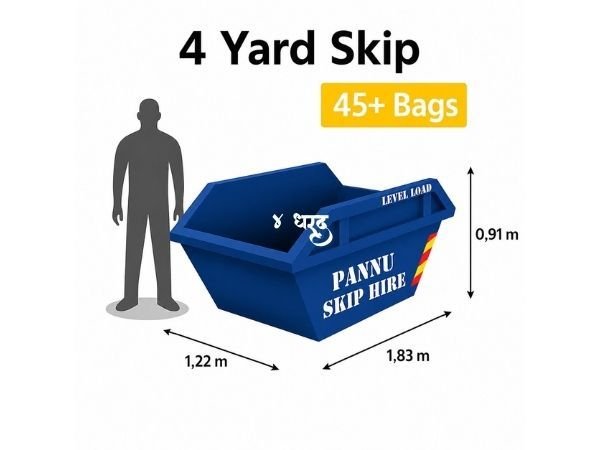
4 Yard Mini Skip
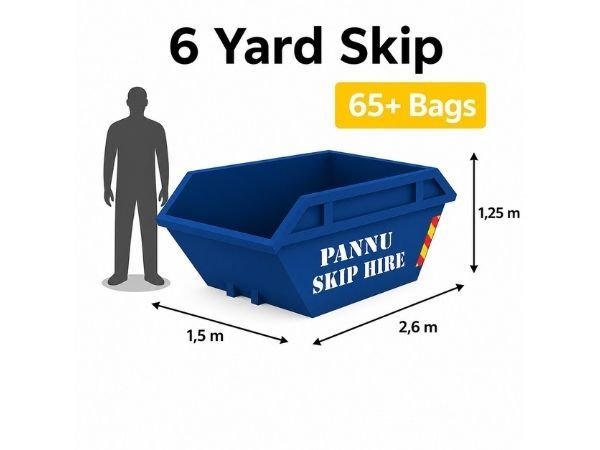
6 Yard Midi Skip (currently unavailable)
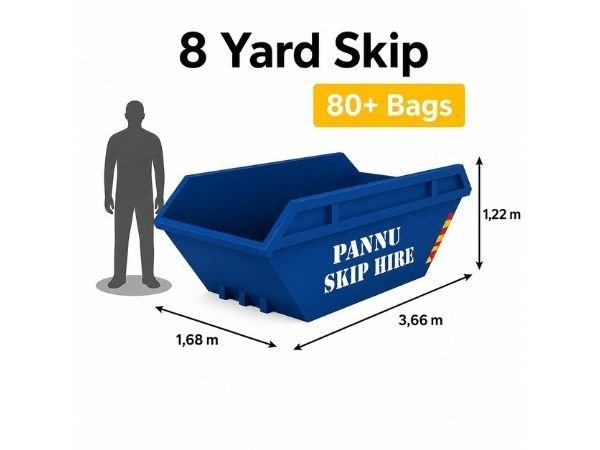
8 Yard Builders Skip
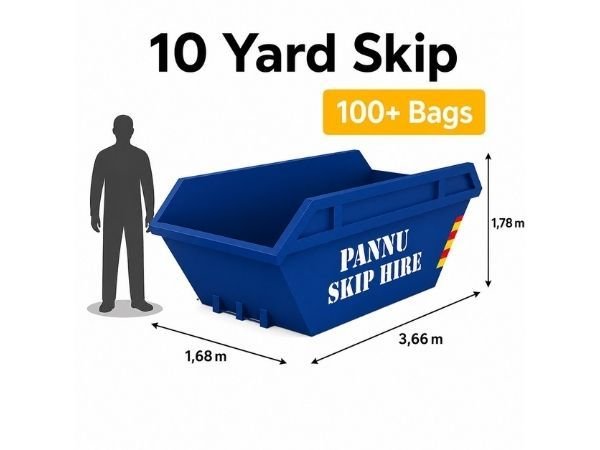
10 Yard Maxi Skip
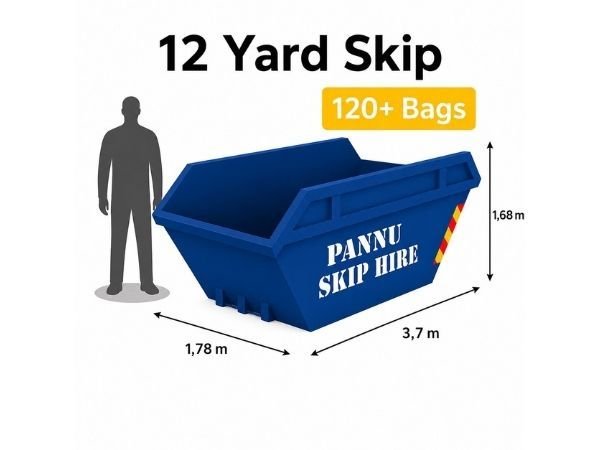
12 Yard Skip
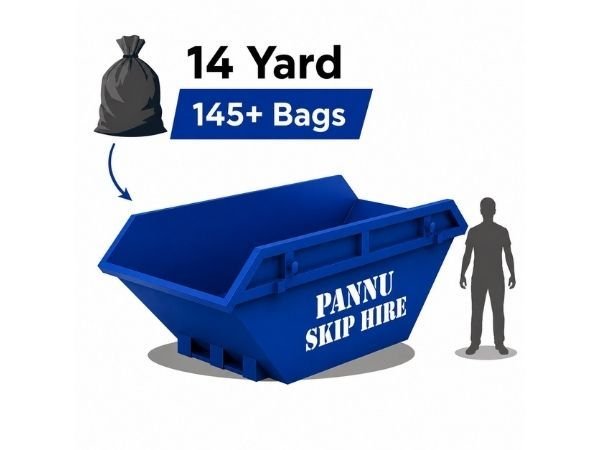
14 Yard Maxi Skip
How to choose the right skip
Almost every wrong order comes down to the same mistake: choosing by how big the job feels rather than by what the waste actually is. Six things decide the answer, and they matter in this order.
1. Weight, before volume
This is the one people get wrong most often. Every skip has a safe carrying weight as well as a capacity, and dense material reaches that weight long before it fills the container.
Soil, brick, concrete, hardcore, floor screed and roof tiles are all heavy. A 4 yard skip full of rubble can weigh more than an 8 yard full of packaging. If your waste is mostly heavy, expect to order smaller than instinct suggests, and expect that to be the cheaper outcome rather than a compromise.
2. Volume, once weight allows it
Light and bulky waste is the opposite problem. Loft clearances, furniture, packaging, plasterboard offcuts and shop fittings weigh very little but swallow space. Here you can go large without any weight concern, and going one size up is usually cheaper than hiring twice.
3. Where it will physically sit
Measure the space before you book, not after we arrive. You need the length of the skip plus room for the lorry to lower and lift it clear, which means clearance above as well as beside it. Overhanging branches, low cables, carport roofs and gateposts all matter.
A useful rule: if two cars park nose to tail in the space, an 8 yard will fit. If only one will, think 4 or 6 yard.
4. Access for the lorry
The skip is only half the problem. A skip lorry needs a straight approach, room to reverse and space to swing. Narrow lanes, tight turning heads on newer estates, parked cars on terraced streets and shared driveways all restrict what we can place.
Tell us the address when you enquire and we will tell you honestly if a size is not realistic there.
5. Whether it needs a permit
Private driveway, no permit. Public road, footway or verge, permit required. This changes both your lead time and your options, because the 12 and 14 yard skips cannot be permitted on the highway at all.
If the road is your only space, your realistic choice narrows to 4, 6, 8 or 10 yard, and you need to allow time for the permit.
6. Budget, honestly assessed
The cheapest skip is the one you only hire once. Two 6 yard skips cost more than one 10 yard, because you pay for delivery, collection and disposal each time. If you are genuinely unsure between two sizes and the waste is light, the larger one is usually the better value.
Where that reverses is heavy waste. There, the larger skip is not just poor value, it is unusable, because you will hit the weight limit with the skip half empty.
The single most useful thing you can do
When you call, describe the material rather than the room. Saying “a bathroom” tells us far less than “a cast iron bath, wall tiles and the old screed off the floor”. The second version gets you the right skip first time.
Skip size comparison
Bin bag figures are a rough guide for planning rather than a guarantee, because a bag of packaging and a bag of rubble are not remotely the same thing. Use the heavy waste column alongside them.
| Skip size | Approx. bin bags | Typical project | Heavy waste | Private land | Road placement | Best suited to |
|---|---|---|---|---|---|---|
| 4 yard mini | 35 to 40 | Bathroom strip out, small garden clear | Yes, ideal | Yes | Yes, with permit | Householders, tight streets, heavy loads |
| 6 yard midi (currently unavailable) | 55 to 65 | Kitchen refit, rental clearance | Yes | Yes | Yes, with permit | Most domestic jobs |
| 8 yard builders | 75 to 85 | Extension, re roof, full refurbishment | Yes, within limits | Yes | Yes, with permit | Builders and trade |
| 10 yard maxi | 95 to 105 | Loft conversion, house clearance | Mixed loads only | Yes | Yes, with permit | Bulky household and light trade waste |
| 12 yard maxi | 115 to 125 | Shop refit, office strip out | No, light waste | Yes | No | Commercial premises with a yard |
| 14 yard maxi | 135 to 145 | Warehouse clearance, commercial fit out | No, light waste | Yes | No | Large volume, low weight clearances |
On mobile, swipe the table sideways to see every column. The 12 and 14 yard skips are private land only because they are too long to be permitted on a public highway anywhere in our area.
The six skip sizes, and who each one is for
4 yard mini skip
Who it is for: householders, anyone on a street with limited kerb space, and anybody clearing heavy material.
Roughly holds: 35 to 40 bin bags.
Typical projects: a bathroom strip out, a garage or shed clearance, a small garden tidy, lifting a path or patio, digging out for a shed base, the tail end of a decorating job.
Waste examples: old sanitaryware, wall tiles, floor screed, broken paving, soil, hardcore, general household clutter.
Advantages: fits on virtually any driveway, takes up the least kerb if it has to go on the road, and it is the correct size rather than a downgrade for dense waste.
Limitations: fills fast with anything bulky. A single mature hedge or one room of furniture will overwhelm it.
Size up if: your waste is light and bulky, or you are clearing a whole room rather than stripping fittings.
Size down to this if: you were considering a 6 or 8 yard for rubble, soil or tiles. You will hit the weight limit long before you fill the larger skip.
6 yard midi skip
Currently unavailable. We are not taking bookings for the 6 yard midi skip at the moment. For a job this size, a 4 yard suits smaller or heavier loads and an 8 yard gives you room to spare. Call or WhatsApp 07861 381 419 and we will recommend the right one.
Who it is for: the majority of domestic customers, and landlords turning properties around.
Roughly holds: 55 to 65 bin bags.
Typical projects: a full kitchen removal, a decent garden clearance, a rental property clear out between tenancies, a bedroom or two of furniture and carpet.
Waste examples: kitchen units, worktops, flooring, tiling, appliances (not fridges), turf, hedge cuttings, furniture, carpet.
Advantages: the best balance of capacity and footprint. It still fits on a standard driveway without blocking the whole thing, and it handles mixed loads well.
Limitations: not enough for a full house clearance, and still weight limited if you fill it with rubble.
Size up if: you are clearing more than two rooms, or the job includes a loft.
Size down if: the load is predominantly soil, brick or concrete.
8 yard builders skip
Who it is for: builders, roofers, and homeowners running a substantial project.
Roughly holds: 75 to 85 bin bags.
Typical projects: a single storey extension, a full re roof, a whole house refurbishment, a driveway replacement combined with other waste.
Waste examples: mixed construction waste, timber, plasterboard offcuts, broken tile, packaging, stripped out fittings, some rubble.
Advantages: the standard trade size for a reason. It takes the mixed output of building work without needing swapping every other day.
Limitations: a genuine caution for roofers. Filled entirely with concrete tiles, an 8 yard will reach its weight limit while still looking half empty. Tell us the tile type when you book.
Size up if: the waste is light and bulky, such as a strip out with a lot of insulation and boarding.
Size down if: you are digging out footings or lifting concrete. Two smaller skips will cost less than one you cannot legally lift.
10 yard maxi skip
Who it is for: full property clearances and jobs producing volume rather than weight.
Roughly holds: 95 to 105 bin bags.
Typical projects: a loft conversion, a complete house clearance, a large garden redesign, a small commercial clearance.
Waste examples: old insulation, boarding, decades of stored belongings, furniture, mattresses, boxes, packaging.
Advantages: this is the largest size that can still go on the road with a permit, which makes it the practical ceiling for anyone without a driveway. For light bulky waste it is far better value than two 6 yards.
Limitations: mixed loads only. It is not a rubble skip, and it needs real space.
Size up if: you have private land and the waste is genuinely light, such as a shop or office strip out.
Size down if: access is tight or there is any significant proportion of heavy material.
12 yard maxi skip
Who it is for: commercial premises with their own yard or service area.
Roughly holds: 115 to 125 bin bags.
Typical projects: a shop refurbishment, an office strip out, a school or church hall clearance, a large volume of packaging.
Waste examples: shelving, counters, partition board, ceiling tiles, workstations, signage, packaging, light timber.
Advantages: moves an enormous volume of low weight waste in one lift, which is usually the cheapest way to clear a commercial space.
Limitations: private land only. It cannot be permitted on a public highway. It is also strictly for light waste, so no rubble, soil or concrete.
Size up if: you are clearing a warehouse or a full commercial fit out.
Size down if: the skip has to go on the road, in which case 10 yard is your maximum.
14 yard maxi skip
Who it is for: the largest low weight clearances.
Roughly holds: 135 to 145 bin bags.
Typical projects: a warehouse clearance, a full commercial fit out, a major site clearance of light material.
Waste examples: pallets, packaging, racking, obsolete stock, fixtures and fittings, large volumes of timber.
Advantages: our largest capacity, and the fewest lifts for a big clearance.
Limitations: private land only, light waste only, and it needs genuine space for the lorry to place and lift safely. Not every yard will take one.
Size up if: not applicable. This is the largest we run.
Size down if: you are unsure whether the space is adequate, or if there is any heavy material in the load.
Which skip is right for your project?
Quick answers by job type. These are starting points; access and material always have the final say.
Kitchen renovation
6 yard. Units, worktops, flooring, tiling and appliances. Break the carcasses down before loading and you will use around a third less space. Stone and composite worktops are heavier than they look.
Bathroom renovation
4 yard. A weight job rather than a volume one. A cast iron bath, wall tiles and floor screed can use the whole weight allowance while the skip still looks part empty.
Garden clearance and landscaping
6 yard for green waste, 4 yard if soil and paving are involved. These two waste types behave in opposite ways. Where a job has both, running a small skip for the heavy material alongside a larger one for greenery often works out cheaper than forcing everything into one.
Loft conversion
10 yard. Almost pure volume: old insulation, boarding, stored belongings, packaging. One of the few domestic jobs where going bigger genuinely saves money.
Garage clearance
4 to 6 yard. Depends entirely on whether it is boxes and tools or old paving slabs and engine parts. Watch for prohibited items here, because garages are where paint tins, batteries, gas bottles and old fridges tend to accumulate.
House extension
8 yard, often more than one. Continuous waste across weeks. Most sites run a rolling swap rather than booking each skip separately. Keep dug out subsoil separate if you can, because it is far heavier than the mixed build waste.
Shop refurbishment
12 yard if you have a yard, 8 or 10 yard if the skip must go on the road. Shopfronts, counters, shelving and flooring are bulky and light. The complication is usually access rather than size, since many high street units have no rear service access.
Office clearance
10 to 12 yard. Desks, chairs, partitioning, filing and cabling. Awkward shapes rather than heavy ones. Plan around building access and lift availability, and think about doing it outside working hours.
Construction site
8 yard on rotation. Mixed waste, heavy at the base of the load. Keep plasterboard separate, because it needs its own disposal route and contaminates a mixed load if it is buried in the middle.
Commercial and trade waste
Depends on the premises. If you have a yard, larger is cheaper. If you are kerbside, 10 yard is your ceiling. Businesses carry a duty of care for their waste, so keep the transfer documentation we provide.
DIY projects
4 yard for most. Weekend jobs almost always produce less than people expect once bulky items are broken down. If you genuinely cannot judge it, describe the pile to us over the phone.
Property and probate clearances
10 yard. Volume is nearly always underestimated because furniture is bulky. A 10 yard is a safer starting point than a 6 for a full house, and it saves the cost of a second delivery.
What can and cannot go into a skip
Accepted waste
- General household waste, including furniture, carpets, boxes and non electrical fittings
- Wood and timber, from floorboards and joists to fencing, pallets and kitchen carcasses
- Metal such as radiators, gates, railings, guttering, pipework and racking
- Bricks, concrete, rubble and hardcore, all dense, so a smaller skip usually applies
- Soil and turf from excavation and landscaping, within weight limits
- Garden and green waste, including hedge cuttings, branches, prunings and turf
- Furniture, broken down where you can to save paid for space
- Cardboard and packaging, the bulk of most retail and fit out clearances
- Plastics, including guttering, non hazardous fittings and packaging
- Mixed construction waste, which is what most building jobs actually produce
- Plasterboard, accepted but kept separate because it needs its own disposal route
What cannot go in, and the reason why
None of these exclusions are arbitrary. Each item is either hazardous, separately regulated, or damaging to the recycling process for everything else in the load.
- Asbestos. Hazardous to health and tightly regulated, requiring a licensed specialist. It turns up in garage roofs, artex, older floor tiles and insulation board. If you suspect it, stop and have it identified before disturbing it.
- Paint, solvents, oils and chemicals. Liquid hazardous waste leaks through a load, contaminates material that would otherwise be recycled, and cannot be separated out afterwards. Fully dried, empty tins are generally acceptable; part full ones are not.
- Gas bottles and aerosols. Pressurised containers are an explosion risk when a skip is tipped or the waste is crushed at a transfer station.
- Tyres. Banned from landfill and legally required to go through a dedicated recycling stream.
- Electrical appliances. Covered by separate electrical waste regulations and recovered through their own route rather than mixed waste.
- Batteries. Car and household batteries contain heavy metals and acids, and are one of the most common causes of fires in waste vehicles and transfer stations.
- Fridges, freezers and air conditioning units. These contain refrigerant gases that must be extracted under controlled conditions before the unit is broken up, which cannot happen once it is in a mixed load.
- Medical and clinical waste. Needles, dressings and similar require specialist handling for obvious safety reasons.
- Hazardous chemicals of any kind, including garden chemicals, pesticides and fuel.
If you are unsure about a particular item, ask before it goes in. A contaminated load costs considerably more to deal with than a two minute phone call, and that cost lands somewhere.
Skip permits explained
Private driveway
If the skip sits entirely on your own driveway or other private land, no permit is required and no council is involved. This covers most of our domestic deliveries and it is always the simpler route where you have the space.
Public road, footway or verge
If any part of the skip sits on the public highway, a permit is required. The highway includes the road itself, the footway and the grass verge, so a skip partly on a pavement still needs one.
This also limits your size options. The 12 and 14 yard skips are too long to be permitted on the highway, so if the road is your only space, 10 yard is the maximum available to you.
Who applies, and which council
You do not apply, we do. Highway authorities require the application to come from the skip operator, and the operator has to be registered with them in advance.
Which authority depends on where you are, and it catches people out. Across most of our Staffordshire area, including Stafford, Penkridge and Cannock, the highway authority is Staffordshire County Council rather than the district or borough council. In Wolverhampton, which is a unitary authority, the city council handles it directly. Each town page sets out the local position in more detail.
Safety requirements
Permitted skips carry conditions around visibility and safety. In practice that means proper reflective markings, lighting at night, and cones where the placement requires them. Councils also set conditions on placement so that a skip does not obstruct drainage, access to premises, fire hydrants or utility covers, and so that pedestrians, including people with mobility or visual impairments, can pass safely.
We handle the markings, lighting and cones as part of a permitted delivery. It is not something you need to buy or arrange.
Planning ahead
The permit has to be granted before the skip is placed, which is the single most common cause of delay. A driveway skip can often go out same day. A permitted road skip cannot, and on town centre streets where the position may need assessing, it can take longer still.
If the road is your only option, tell us at the point of enquiry rather than the day before you need it.
We are describing how the process works rather than giving legal advice. Current conditions and fees are published by the relevant highway authority.
How skip delivery actually works
1. Booking
Call, WhatsApp or use the quote form. Tell us your postcode, describe the waste, and say whether the skip is going on a driveway or the road. That last detail changes the lead time, so it is worth mentioning first.
2. Choosing the size
We will recommend a size based on what you describe. If we think you are about to over order we will say so. A skip you cannot fill is money wasted, and a skip too heavy to lift is a wasted delivery for both of us.
3. Delivery
The lorry needs a clear approach, room to reverse and overhead clearance to lower the skip. Move cars, bins and anything else in the way beforehand. If the driveway is block paving, tarmac or resin, put scaffold boards down first, because a loaded skip is heavy enough to mark it.
For permitted road placements we position the skip according to the permit conditions and fit the required markings and lighting.
4. Loading
Heavy material at the bottom, spread evenly rather than piled at one end. Break down furniture and flatten packaging as you go. Load level with the rim and no higher, because an overfilled skip cannot be sheeted safely and cannot legally be lifted.
If you misjudge the volume, tell us and we will arrange a swap rather than leave you stuck.
5. Collection
Give us a rough finish date when you book and we will plan around it. If the job overruns, tell us and we will extend or swap. Permitted road skips are less flexible, because the permit runs for a fixed period.
On collection day the skip needs the same clear access it needed on delivery.
6. Sorting and recycling
The load goes to a licensed waste transfer station rather than straight to disposal, where it is separated into streams. That process is set out in the next section.
What happens to your waste after collection
A skip has not been a one way trip to landfill for a long time. When we collect, the load goes to a licensed waste transfer station to be sorted.
How sorting works
Bulky items come off first. The remainder is separated into streams: timber, metals, inert material such as brick and concrete, plasterboard, green waste and general residual waste.
Timber is chipped for board manufacture or biomass. Metals are recovered for reprocessing. Inert rubble is crushed into secondary aggregate and frequently goes back into construction as a sub base. Green waste is composted. Only the genuinely non recoverable fraction goes to final disposal.
Why segregation on site matters
What you put in directly affects how much comes back out. A single tin of paint tipped into a mixed load can contaminate material that would otherwise have been recycled, turning a recoverable load into a disposal one. Keeping plasterboard separate matters for the same reason.
This is the practical argument for the prohibited items list, and it is a better one than simply saying the rules require it.
Your duty of care
Under UK law, the person or business producing waste holds a duty of care for where it ends up, and that duty does not end when the lorry pulls away. Using a carrier registered with the Environment Agency, and being able to evidence it, is how that duty is met.
Our waste carrier registration is CBDU576197 and you can check it on the Environment Agency public register. We would encourage you to check it for any company you use, not just us.
Skip hire questions, answered
Service areas across Staffordshire & the West Midlands
We run skips across Staffordshire and the West Midlands from our yard at Whiston Mill in Penkridge. In practice that means the A449 corridor between Stafford and Wolverhampton, past Penn on the city fringe, east across Cannock Chase, and out into the villages in between.
Four of our main areas have their own pages with local delivery notes, permit rules and access advice. The rest are covered exactly the same way, we simply have not written the page yet.
Stafford
Skip hire across Stafford
Cannock
Fast delivery in Cannock
Penkridge
Our home base & surrounds
Wolverhampton
Domestic & commercial
Walsall
Skip hire across Walsall
Rugeley
Reliable local coverage
Stone
Skips delivered to Stone
Lichfield
Skip hire across Lichfield